
Successful global companies compete in different industries, serve different customers, and pursue different strategies.
Some manufacture products.
Others deliver services.
Some grow through acquisitions.
Others expand organically.
Yet despite these differences, the organizations that consistently scale across borders tend to share a common set of operating characteristics.
Their success is not simply the result of superior products or larger budgets.
It reflects the way they are designed to operate.
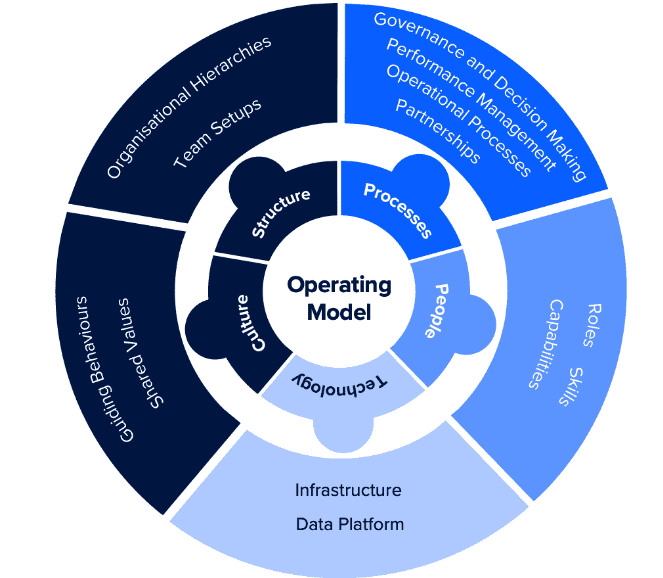
An operating model is more than an organizational chart.
It defines how decisions are made, how information flows, how accountability is assigned, and how work is coordinated across the enterprise.
When designed well, an operating model allows an organization to grow without becoming slower, more fragmented, or more difficult to manage.
They Standardize the Critical, Not Everything
Many organizations struggle to find the right balance between global consistency and local flexibility.
Great global companies understand that not everything should be standardized.
Customer engagement, marketing approaches, and local relationships often require adaptation.
However, the processes that protect enterprise performance should remain consistent.
These typically include:
- Financial reporting
- Risk management
- Performance measurement
- Decision rights
- Compliance standards
Consistency in these areas creates confidence without eliminating local responsiveness.
They Build Clarity Into Decision-Making
As organizations expand, the number of decisions increases dramatically.
Without clearly defined authority, routine issues begin moving upward through the organization.
The strongest operating models prevent this.
People understand:
- Which decisions belong locally.
- Which require regional coordination.
- Which remain enterprise decisions.
Clear decision rights improve speed while strengthening accountability.
They Create Enterprise Visibility
Leadership cannot manage what it cannot see.
Great operating models provide executives with consistent information across markets.
The objective is not more reporting.
It is better reporting.
Comparable performance measures, common definitions, and timely information allow leaders to identify trends early and respond with confidence.
Visibility supports better decisions because it reduces uncertainty.
They Balance Autonomy With Alignment
Local markets require flexibility.
Corporate leadership requires consistency.
Successful organizations avoid choosing one over the other.
Instead, they establish enterprise principles that allow local teams to adapt while remaining aligned with broader strategic objectives.
This balance enables innovation without sacrificing organizational coherence.
They Develop Capability Continuously
Strong operating models are not static.
As organizations grow, they continuously refine leadership capability, decision-making processes, technology platforms, and governance practices.
Every expansion becomes an opportunity to strengthen the enterprise rather than simply increase its geographic footprint.
Growth becomes cumulative because organizational capability grows alongside revenue.
They Treat Governance as an Enabler
One of the most common misconceptions is that governance slows organizations down.
In well-designed operating models, the opposite is true.
Governance reduces uncertainty.
It clarifies accountability.
It creates consistency.
Most importantly, it allows decisions to be made confidently at the appropriate level.
Good governance does not create bureaucracy.
It creates organizational confidence.
The Leadership Question
Executives should periodically ask:
If our organization doubled in size over the next three years, would our operating model make that growth easier—or more difficult to manage?
The answer often reveals whether the organization has built a scalable enterprise or simply a larger one.
The Bottom Line
Great global operating models are not defined by industry or geography.
They are defined by design.
They create clarity instead of confusion.
Visibility instead of uncertainty.
Consistency instead of fragmentation.
They enable local responsiveness while protecting enterprise performance.
Most importantly, they allow organizations to scale without depending on constant executive intervention.
Markets may create opportunities.
A well-designed operating model determines whether those opportunities become sustainable competitive advantage.